Author Archives: Jane

Sew 26 – Australia Day fancy dress

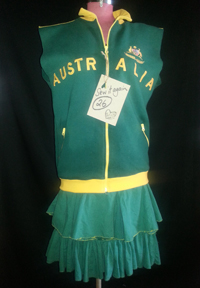
Australia Day dress-upToday’s outfit is a tilt to Australia Day, created using a jacket salvaged from the reject pile when my son Max left home and a skirt from my op-shop stash which is a perfect colour-match.

This Australia Day, I am proud that champion footballer and anti-racism campaigner Adam Goodes is 2014 Australian of the Year because he is a great story of turning adversity into triumph through integrity, thoughtfulness, and hard work.

And of course, being Australia Day we’re on a countdown to the Triple J Hottest 100 which plays at parties across the nation.

I feel on-trend with my Sew it Again project because it was just two years ago in 2012 that the No 1 song was Michael Macklemore’s Thrift Shop about opportunity shopping and giving pre-loved clothing a second life. Continue reading

Sew 25 – Back to front makeover

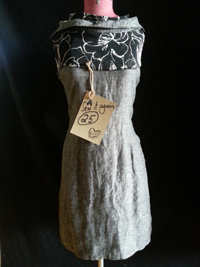
upcycling shirtmaker dressJazz up a shirtmaker linen dress by turning it back to front, cutting off collar, adding scarf and resewing collar in reverse.

This upcycle marks day 25 of my Sew it Again campaign in which I am on a journey that aligns my values, personal and professional background, skills, instinctive creativity, love of nature and interest in pioneering new opportunities.

It springs from study last year with the Australian Rural Leadership Program in which I identified as a post-conventional leader working at individualist and strategist levels.

According to Rooke and Torbert in Harvard Business Review April 2005, strategists typically have socially conscious business ideas that are carried out in a highly collaborative manner. They seek to weave together idealist visions with pragmatic, timely initiatives and principled actions. Rooke and Torbert’s leadership model outlines a step-wise, logical evolution in leadership capacity built through experience and self-awareness.

Another insight I gained from study was I am an INFP. And thanks to my Twitter friend Lisa Claessen, I was inspired to read via this website that INFP-character traits defined as:

  • Introverted: composed, self-reliant, reserved and thoughtful
  • Intuitive: creative, imaginative, idealistic and innovative
  • Feeling: empathetic, sensitive, ethical and authentic
  • Perceiving: flexible, accepting, tolerant and open-minded

Truity says INFPs are imaginative idealists, guided by their own core values and beliefs. They see potential for a better future, and pursue truth and meaning with their own individual flair.

Individualistic and non-judgmental, INFPs enjoy spending time exploring their own ideas and values are creative and often artistic; they enjoy finding new outlets for self-expression.

INFPs value authenticity and want to be original and individual in what they do. They are often concerned with a search for meaning and truth within themselves. Following tradition holds little appeal for the INFP; they prefer to do their own exploration of values and ideas, and decide for themselves what seems right. INFPs are often offbeat and unconventional, but they feel no desire to conform. The INFP would rather be true to themselves than try to fit in with the crowd.

The INFP may react strongly if they feel their own values are being violated, and they want an open, supportive exchange of ideas.

INFPs engage themselves in a lifelong quest for meaning and authenticity. They often have a special affection for the arts, especially the avant garde, as they love experiencing new concepts in self-expression. (Find your type here.)

Well that explains it!  For all of the above reasons, I’m spending 2014 on a values-based creative quest to demonstrate a different way of dressing that is sustainable, unique and rewarding.

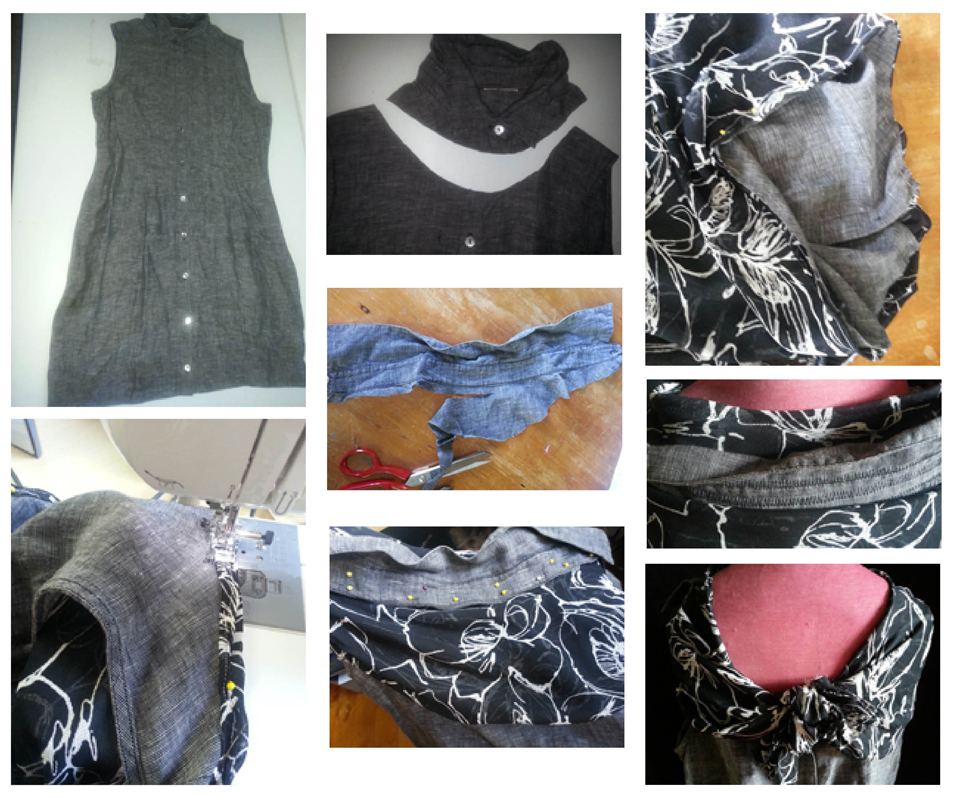
This shirtmaker dress has intrinsic value for its lovely linen and shell buttons, but the style was dated. I cut off the collar, added a scarf to the neckline leaving the loose ends to tie in a knot at the buttoned back of the dress (which had been the front). I then sewed the collar on the front of the dress (which had been the back). In reality, the dress can be worn either way around – so it now has a second and third life!

how to update shirtmaker dress

Sew 24 – Repurpose skirt to frock

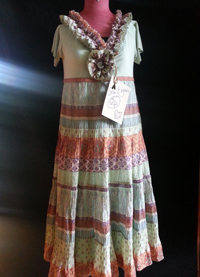
skirt becomes frockHere’s another long skirt that wasn’t being worn which I’ve turned into a dress by using part of a top which is embellished with a strip torn from the skirt hem.

At my book club last night with fabulous, feisty, feminist, professional women I’ve been gathering with for more than a decade, I was thrilled to learn several are now dusting off their sewing machines and rediscovering the freedom of sewing.

In her book Sew Retro: a stylish history of the sewing revolution, Judi Ketteler writes about feminist history and women’s role in the home in the nineteenth century when everything was sewn by hand. Then in the twentieth century, women won the right to vote, cut our hair, ditched our corsets and joined the work force in earnest.

Ketteler says sewing was on its way out during the self-indulgent 1980s but is now making a huge comeback, thanks to a third wave of feminism that folded together ideas about DIY creativity, self-reliance, and eco-awareness.

“We don’t need stats to see the role that sewing now plays in so many women’s lives. Women carry their handmade bags to the grocery store, sport ‘upcycled’ denim skirts, and proudly give their handmade creations to friends and family. It’s a long way from 1941, but we’re still ‘sewing for victory’ – a victory over mass-produced, resource-greedy, uninspired, and cheaply made products. “

“We sew to support our families, to release tension from balancing work and family, to clothe the needy, to make a political statement, to celebrate a cancer survivor, to spoil our pets, to save a little money, to make our grandmothers proud, to teach our daughters how to think and live creatively, and just for pure, sweet pleasure.”

When Ketteler wrote this book in 2010, she said “sewing is about empowerment, creativity, sustainability, and sometimes sticking it to The Man. I can’t imagine a better place for sewing to have ended up.”

My Sew it Again project is not just about sewing, it is about re-sewing and demonstrating a different way of dressing. I am repurposing existing garments that have been discarded for various reasons and giving their gorgeous natural fibres a second chance at life.

Today’s offering was a Sportscraft skirt made of pretty printed silk-blend fabric which I merged with part of a stretch knit top to become a frock by sewing them together. The skirt is about 4m circumference at the bottom, and I tore a strip off it to shorten the skirt and provide a gathered feature around the neckline. To tear the strip, you begin with a small cut and then grip your thumb and forefinger close to the edges and tear. It is a satisfying action because you keep moving your hands along the fabric until you get to the other end. I sewed a gathering thread along the middle of this strip, pulled it up and pinned then sewed the strip around the front and back of the top, using the remainder to form a flower feature at the front.
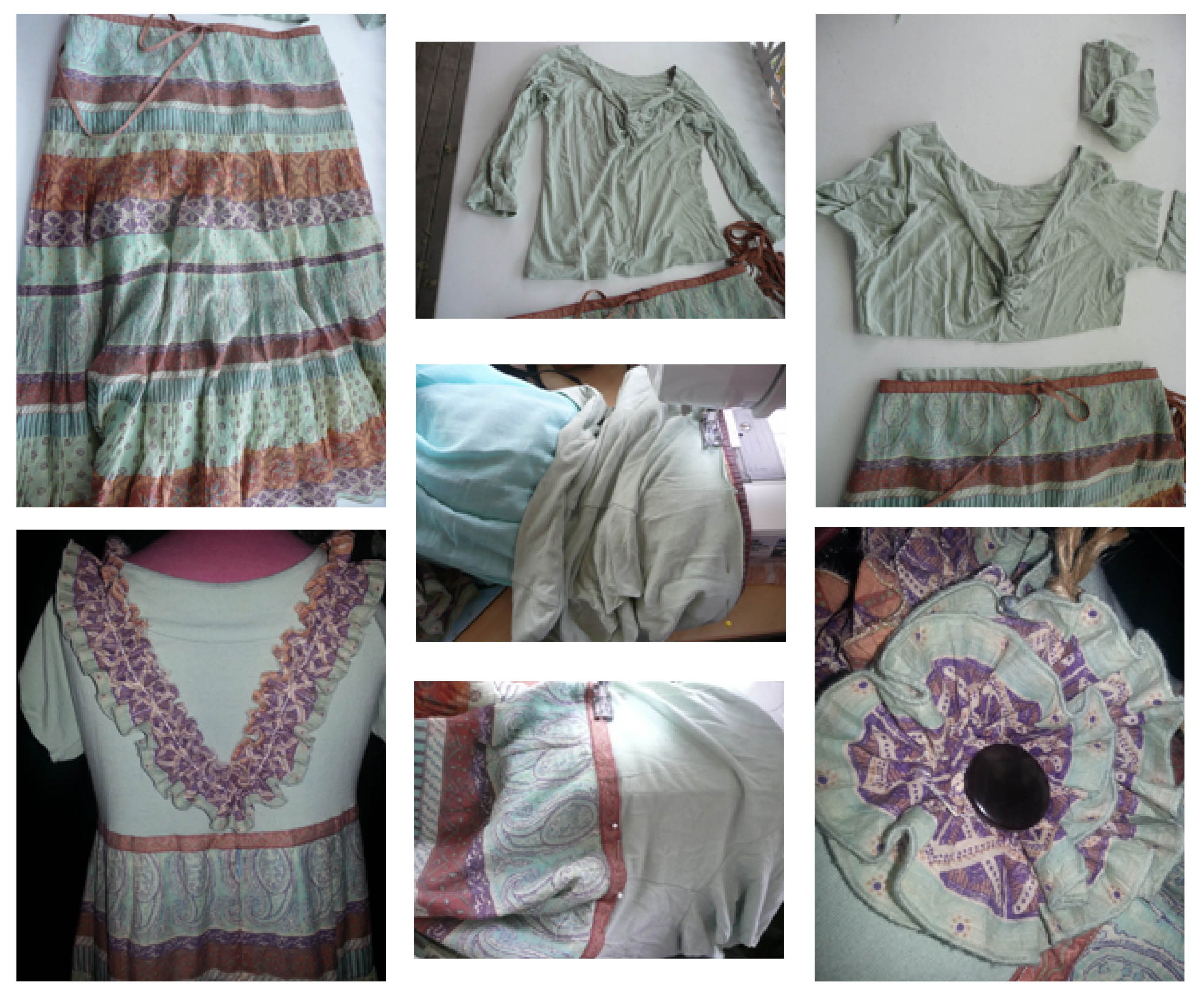
skirt becomes dress

Sew 23 – Upcycle by hand-sew and knots

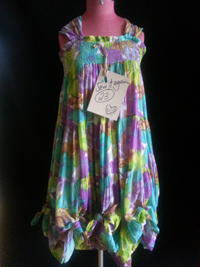
upcycled summer dress Upcycling can be achieved without a sewing machine as I did by turning this old cotton dress into a muumuu, hand-sewing shoulder straps and knotting the hemline to create interest.

It is empowering to take any old garment and recreate it into something more wearable – and I’m fascinated to be reading and researching others doing this around the world, including the Centre for Sustainable Fashion in London.

By actions and choices, we as individuals can make changes to reduce the burgeoning rate of textile consumption which has been increasing three times faster than the population.

Much of this increased textile use is man-made fibres created using petroleum, coal and gas – which feeds into the whole consumption and disposal issues associated with fast-fashion trends.

NASA reported this week that high temperatures last year were part of a sustained long-term climate warming trend and in Australia, where I live, 2013 was the hottest on record.  Continue reading

Sew 22 – Repurposed trousers to skirt

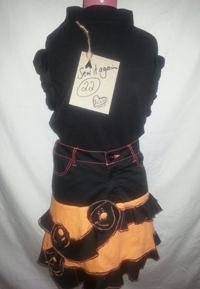
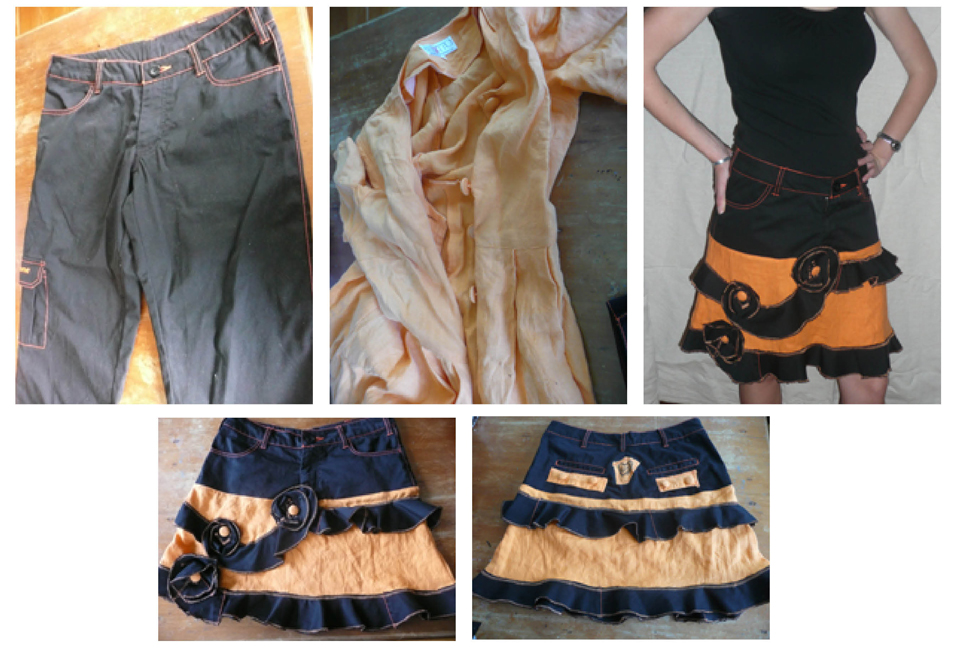
trousers become skirtThis was a pair of reject promo trousers that I converted to a skirt by adding an A-line extension from an orange dress which I decorated with circular frills cut from the trouser legs.

Everyone I know has excess garments in their wardrobes. The world is awash with clothing that is no longer fit for purpose, so it makes sense that instead of dumping it in landfill we convert it into something else.

It is disconcerting to read that Australians have the largest homes in the world – after the United States and Canada – and I’m sure this equates to having the biggest wardrobes too!

According to Lindsay Wilson from Shrink that Footprint, the average new home in Australia is 214 m2, the US 201 and Canada 181 m2.  The countries with the smallest homes are Hong Kong 45, Russia 57, the United Kingdom 76 and Italy with 81 m2.

I live in a big old Queenslander in Brisbane and I’m mindful that our family has accumulated a lot of stuff over the years. In our defence, most of it is pre-loved treasure, gathered from relatives, flea markets, op shops or friends cast-offs – and a lot of found stuff from nature including rocks, driftwood and shells.

On my 365-day upcycling journey this year, I’m working my way through the wardrobes of natural fibre garments I’ve gathered from ops shops and other sources in recent years.

Today’s upcycle was black cotton trousers from the $2 rack at an op shop, which was branded with advertising but appeared new. I cut them off below the zip and added new front and back panels cut from an orange dress to extend the skirt to above-knee. I cut open the leg off-cuts and used a circle pattern (sorry forgot to photograph this) to cut lengths of frill which I then sewed around the skirt. I made flowers from the leftover bits and sewed salvaged buttons at each centre. The top was one I made years ago with the sleeves rolled up.

Sew 22 construction web

Sew 21 – Skirt with a story to tell

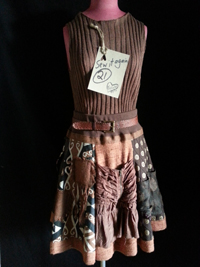
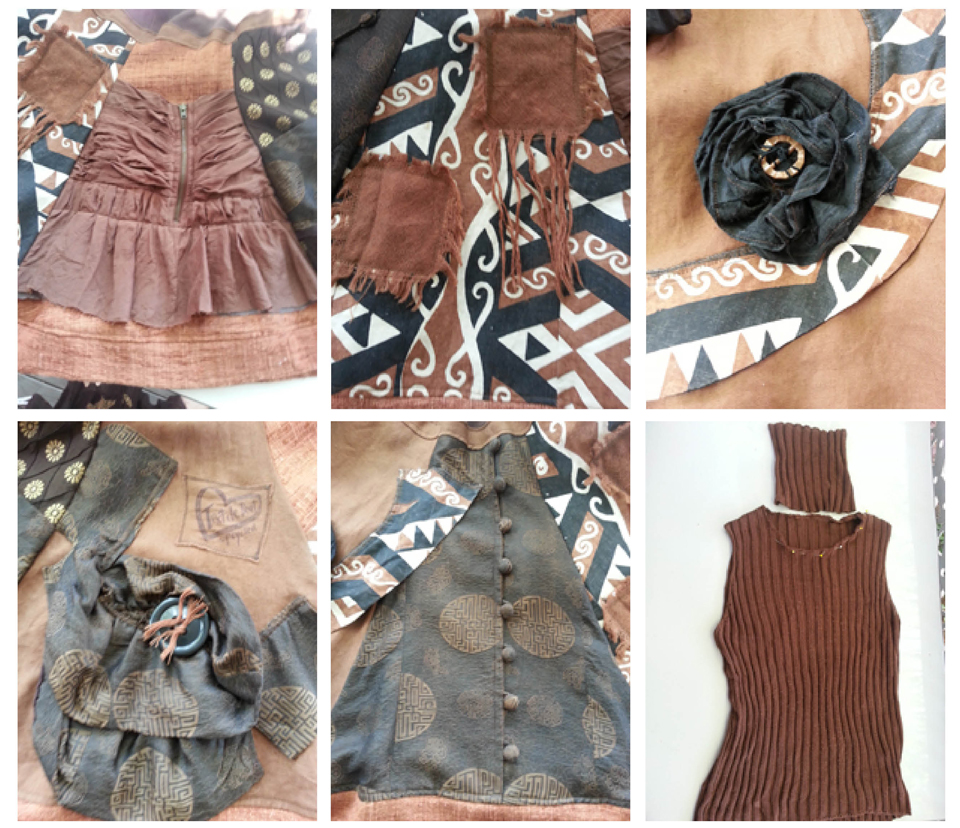
chocolate swirl history skirtThis history skirt is upcycled from five reject garments made of silk, screen-printed cotton, linen and vintage buttons found at opportunity shops during a road trip up the Queensland coast.

History skirts are an original design and concept which I created based on a gored skirt pattern. It was inspired by a shirt I bought from the amazingly creative Mary Ede of The Skirt, who is based in Townsville north Queensland.

I wondered what could be done with all the natural fibres, fabrics and found stuff I was rescuing from op shops along the way – and the Textile Beat creative business/social enterprise and this Sew it Again project are results of that wondering.

It is rewarding when people like champion swimmer, expert trainer and stylish dresser (among other things) Lisa Curry support one’s efforts.

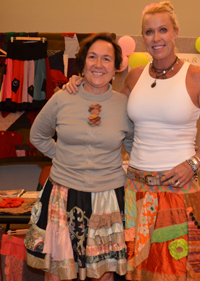
Last year, when Lisa Curry stepped into Blackall Cultural Centre while on her Aussie road trip inspiring health and wellbeing, her attention was immediately captured by my history skirts.

Lisa Curry wears Textile Beat webWhile Lisa’s eyes were drawn to its colour and creativity, her decision to purchase this upcycled natural fibre garment demonstrates support for slow fashion as one small way to boost ecological health and reduce our carbon footprint.

I posted this story of Lisa’s orange and avocado history skirt: “It was handcrafted in Brisbane by Jane Milburn from at least 10 upcycled fabric sources including an Italian linen dress, silk shirt and tie, rayon vest, cotton scarf, floral cotton from Nana’s fabric box, vintage buttons and more.”

I’ve got Col Jackson from Blues Country Magazine to thank for this photo taken at the QRRRWN annual conference, and my Australian Rural Leadership Program colleague Ele Cook from Coolah in New South Wales to thank for helping me follow my heart on this creative journey inspiring the upcycling of natural fibres for pleasure, reward and sustainability.

This chocolate swirl history skirt has several pockets for gadgets and each panel has a feature created from off-cuts.  It is brought together by a stretch-knit waistband and hemmed with a border of raw silk. Because the construction is time consuming, it is a labour of love. I’ve teamed this skirt with a knit top from which I removed the roll collar and hemmed with zigzag.

cotton and silk history skirt

Sew 20 – Inspired by junky style

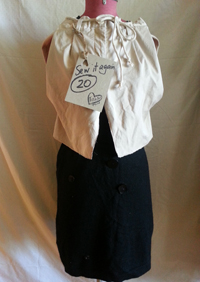
Officewear with a differenceThis outfit is cotton trousers turned crop-top and wool jumper turned skirt – with the top inspired by Junky Styling’s wardrobe surgery and the jumper-skirt being from my own imagination.

I’ve been upcycling on-and-off for decades but became more serious two years ago when I rediscovered op shops and took to ‘rescuing’ natural fibre clothing selling for a song – some perfect some dated or damaged but all worthwhile resources.

At one stage I had 100 wool jumpers, many more than needed for Brisbane’s mild winter, so I converted some into easy, comfortable skirts with the sleeves being used as neck scarves.

Five wardrobes later and doing leadership study last year, I looked around the world via the internet and came across the wardrobe surgery being done by Annika Sanders and Kerry Seager in London.

I discovered their book Junky Styling Wardrobe Surgery which ignited fresh ideas and affirmed my commitment to upcycling natural fibre garments for pleasure, reward and sustainability.

In Junky Styling, Annika and Kerry write: “Recycling worn, discarded, second-hand clothing involves taking a garment that already has an identity and looking at it as a raw material, studying the existing form and details, then applying them to a new design – a complete reinterpretation and disregard for the existing identify of the piece. This involves a vision and an understanding of form and functionality.

“We reckon that you can recycle anything, and it’s a wonderful way to engage our imaginations. With such a vast array of materials used in clothing, we have always maintained that distinction between ‘natural’ and ‘manmade’ fabric. The quality of natural textiles has always made them first choice for our raw materials. Our first clothing creation was made from a pure wool grey pinstripe suit; the feel, strength and durability of the cloth impressed and continues to inspire us. The cloth also helped to define the identity of Junky Styling as a ‘new take on tailoring’. With no attention paid towards promoting an image or branding, the raw materials spoke for themselves and showed that Junky Styling was all about lasting quality and sustainability.

“Recycling is extending the life of an item. Nothing exceeds its ‘sell-by date’ – the date just changes and keeps changing, continually updating until the fabric falls apart.”    View video clip here.

We all have unworn clothing in our wardrobes and my 365-day Sew it Again project is demonstrating how you can update yours using simple home-sewing techniques.

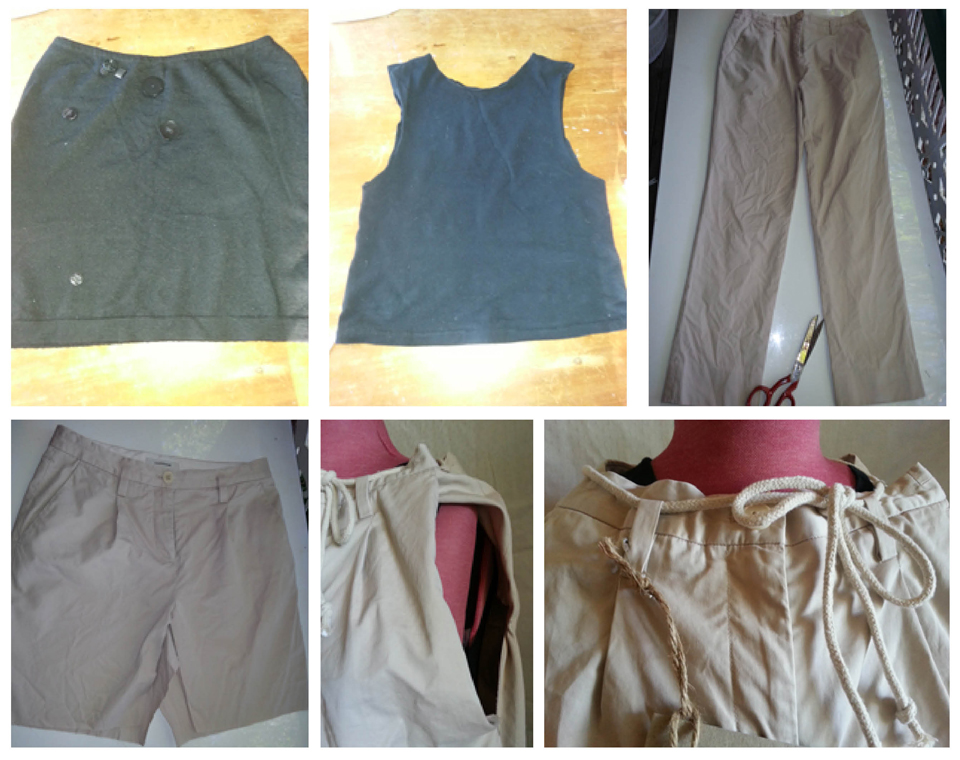
This jumper skirt was an old wool pullover – conversion technique shown in my Stitch in Time column October 2013 – the holes in which were covered by sewing on buttons. The black singlet was a cotton lycra off-cut with seams just zigzagged to finish. With the Country Road trousers, I cropped the legs off, cut away the inside seams and zigzagged around the bottom edges. I created armholes by cutting away the pockets and extending the opening by unpicking the side-seam until it was comfortable. I found a cord in my string box and used it to draw in the waistband/neckline.

jumper skirt and trouser top conversion

Sew 19 – Creativity in dress

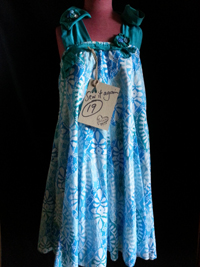
summer cotton dressIt took several additions to be satisfied with this dress and I am still not entirely so. It is a bit twee, lacking creative spark.

Creativity is an interesting quality, which my edition of the Macquarie Dictionary defines as the state or quality of being creative. Creative, adj, 1. having the quality or power of creating. 2. resulting from originality of thought or expression. 3. originative; productive.

As an agricultural science graduate, creativity didn’t feature much in my formal education and I always scratched my head when encountering star sign characterisations of Pisceans which generalised us as artistic types.

It was only after children and having fun with paint, clay and glue that I began experiencing the potential for creativity and the concept of producing something out of not much.

More recently while pausing again to look around my world and undertake further study, I read Deepak Chopra who identified creativity as one of the most significant spiritual laws in The Seven Spiritual Laws of Superheroes

Chopra defines creativity as a leap in consciousness that brings new meaning or new context to any situation or problem. Cultivating creativity turns problems and obstacles into challenges and opportunities. In every adversity there is a seed of something magnificent.

He says creativity is the principal force that drives all life, evolution and the mechanics of science. To effectively harness creativity and lead in your life, Chopra recommends:

  1. Determine what to get rid of – what in your life detracts from its quality and is unnecessary? Commit to letting go of whatever it is that is holding you back, including toxic habits, emotions, relationships, substances and environments.
  2. Practice clarity of vision – what do you want to create? Ask yourself what you really want, why you really want it, and if manifesting it will serve a higher purpose for humanity
  3. Follow the nine steps to accessing your creativity with diligence and detachment. The steps are: intended outcome; information gathering; information analysis; incubation; insight; inspiration; implementation; integration and incarnation.

I’ve taken these thoughts on board in developing this Sew it Again campaign as a personal leadership response to the burgeoning waste of textiles and clothing churn I see all around us. I am now in the implementation phase – Day 19 of a 365-day demonstration of upcycling natural fibre garments for pleasure, reward and sustainability.

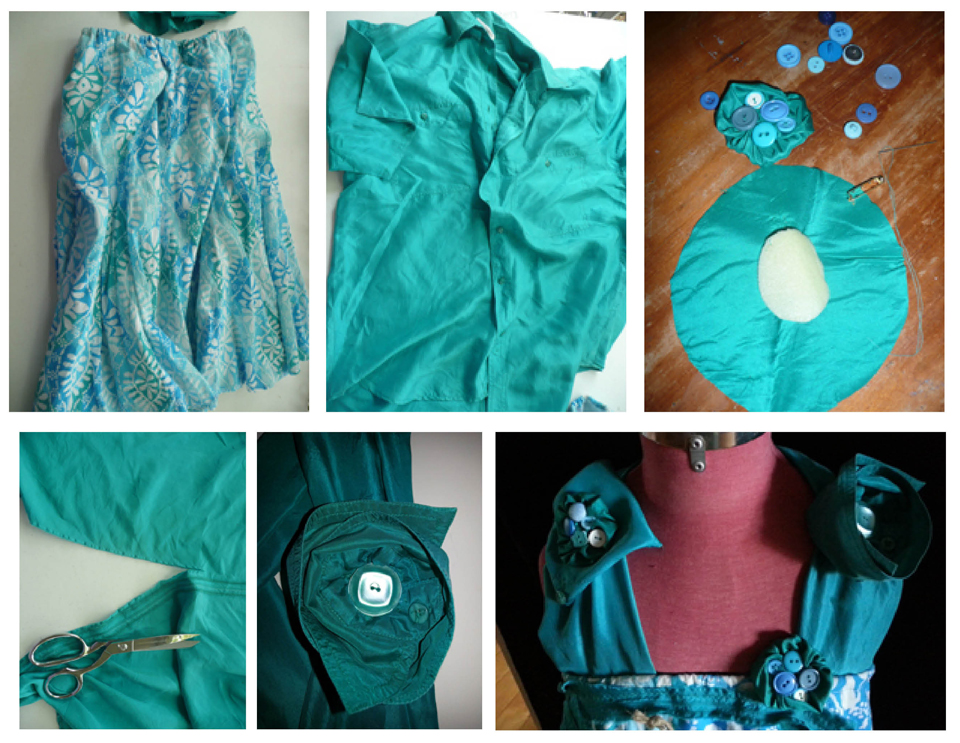
From my op shop stash, I used an old silk shirt to create straps and embellishments to turn this skirt into a dress. I used the former shoulder pads to create button brooches, which looked a bit too neatsy on their own, so I gathered up the collar to create another brooch and randomly stitched another torn strip from the shirt across the dress front.

convert summer skirt to dress

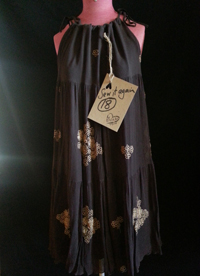
Sew 18 – Silk skirt now dress

silk skirt to dressI love recreating cast-offs into something fresh, as I did by turning this beautiful but unworn long silk skirt from an op shop into a comfy and cool shift dress.

For everyone, clothing is essential. As well-known Australian designer and champion of natural fibres Liz Davenport said in Management Today September 2013, ‘you can get to an event without a car and without breakfast … but not without clothes’.

Clothing choices impact on our well-being, self-esteem and self-image, but there is a bigger picture to consider as we become mindful about where clothes come from and their true cost.

In Sustainable Fashion and Textiles, Kate Fletcher has written a definitive text on this subject in which she says the reuse of textile products ‘as is’ brings significant environmental savings. The energy used to collect, sort and resell second-hand garments is between 10 and 20 times less than that needed to make a new item. Continue reading

Sew 17 – Old-new not new-new

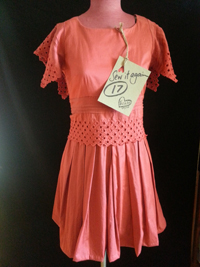
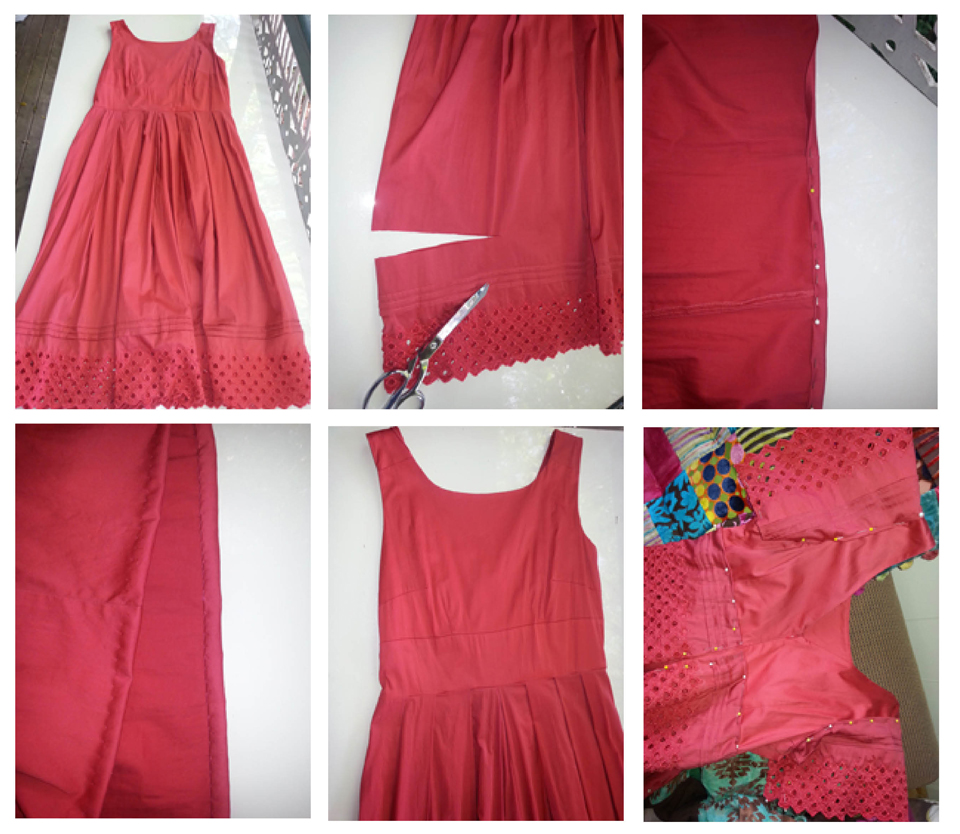
pink cotton dressThis cotton dress once was sleeveless and long now is short with peplum and sleeves following a hand-sew modification.

It was a $2 purchase from the op shop sale I wrote about in this post  – op shop sales being just as frequent as sales in the thousands of dress shops and department stores pushing newer, brighter, seemingly ever-cheaper clothing.

In her book Overdressed: The shockingly high cost of cheap fashion, New York-based writer Elizabeth L. Cline said that for many consumers, part of the appeal of cheap fashion is that it allows them to get rid of their purchases when newer, more with-it items come along.

She sites astonishing textile consumption figures when clothing is combined with sheets and towels. Every year, Americans throw away 12.7 million tons, or 68 pounds of textiles per person, according to the Environmental Protection Agency, which also estimates that 1.6 million tons of this waste could be recycled or reused.

You might think this clothing churn is not bad for the environment because some of it can be reused, but Elizabeth says a tremendous amount of clothing is in fact not getting recycled but getting trashed, and the environmental impact of making clothes is being entirely overlooked.

There’s a large disconnect between expanding wardrobes and the additional demands for fossil fuels, energy and water – and the resulting impact on our environment and climate.

As an agricultural scientist and journalist, it is from the perspective of reducing and reusing natural resources that I’m undertaking this Sew it Again campaign to demonstrate simple ways we can upcycle natural-fibre clothing from our own and others’ wardrobes.

Today’s watermelon pink cotton dress was adapted with hand-sewing done while chatting and watching TV. I trimmed the bottom from the long skirt to make it knee length then used the hem off-cut as a peplum around the waist and to create sleeves. It took a little time, but was not difficult and the rhythm of the needlework was relaxing and satisfying. It reconnected me to skills I learned from previous generations of my family, when home-sewing was as natural a part of everyday life as home-cooking. I have an aversion to ironing and find that giving cotton good shake after washing and smoothing the crinkles by hand is enough to avoid the need for it.

adapting a cotton dress