Author Archives: Jane

Sew 46 – One from the gestational file

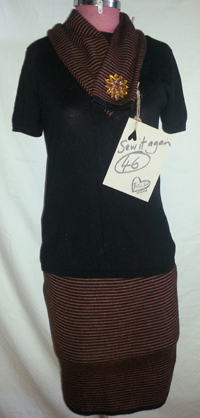
Jumper skirtThis orange and black stripped outfit once was a woollen jumper which I’ve turned into a jumper-skirt with sleeves as a neck scarf, teamed with a wool top.

It’s from my files because I was distracted at the Rural Press Club, catching up with journo mates such as Jane Paterson, Steve Gray, Gordon Collie, Teena Girdis, Neroli Roocke and meeting new ones Sue Neales from The Australian and Cassandra Hough from ABC Toowoomba, respectively runner-up and winner of the Excellence in Rural Reporting awards.

The link between the rural sector and what I’m doing here with Sew it Again is not immediately obvious until you think about where your clothes come from. They’re either made from natural farmed resources (wool, cotton, flax, hemp, alpaca etc) or man-made from petroleum, oil or gas.

After the Rural Press Club I went to Avid Reader bookshop in West End to pick up my newly-arrived copy of The Sustainable Fashion Handbook by Sandy Black (I just had to have my own copy), bumped into my dear friend Kay Pearse who is off to the US tomorrow, and then it was time to pick up Darcy from a city meeting and on to the airport to pick up son Max.

A fun day but no time at home feeding the baby – model Mabel needed a change of clothes!  Continue reading
Sew 45 – Love for natural resources

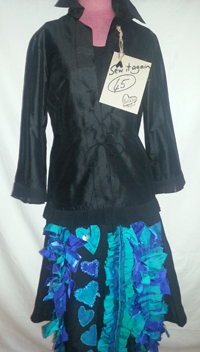
upcycled silk skirtBusiness attire is dress code for today’s Rural Press Club lunch at Tattersalls so I’m wearing this black silk top (found in op shop as is, never worn) teamed with silk-embellished linen skirt.

Speaking today is National Farmers’ Federation president Brent Finlay about the future for family farming in Australia, in what is the UN’s International Year of Family Farming 2014.

About 99 percent of Australian farms are family-owned and operated, but the challenges involved in growing food and fibre for the world include drought, low profitability, rising debt and a dwindling rural workforce.

In addition to being NFF president, Brent is a wool producer from the Traprock region of southern Queensland whom I met 15 years ago at a Wear Wool Wednesday fashion parade in the Red Chamber at Queensland Parliament House when I was working for then Minister for Primary Industries Henry PalaszczukContinue reading

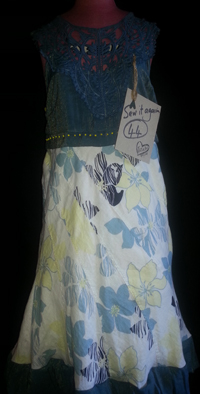
Sew 44 – What is it all for?

silk/linen upcycled dressThis dress was created by sewing a linen skirt to the top of a cotton/silk shift because the blue and yellow shades in both looked as if they were meant to be together.

Some things are just meant to be – and I think this year in the rhythm of sewing, photographing, writing and posting about my resewing experiences is one of those things.

I’m currently working out how to manage this rhythm while in Western Australia next month, my third trip west during the past year since my youngest brother Paul lost his life in an excavator accident there.

Losing a much-loved sibling is painful, as well as a wake-up call for what really matters. Paul was living an adventurous life in his Mercedes Sprinter van fitted out as a mobile home/tool kit, working as a builder in remote parts of the state. He had no children, was twice married and twice divorced.

Paul didn’t leave a Will, so part of my journey this year after being appointed as administrator is deciding what to do with his possessions. Less is more and quality remains long after price forgotten were codes by which Paul lived – and I’m fortunate he gathered a couple of high-quality friends who are helping me work through this process. Continue reading

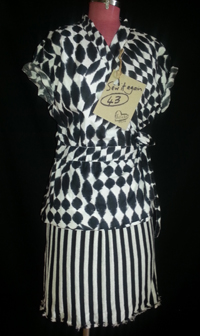
Sew 43 – Black & white rerun

black and white outfitClothing can be endlessly upcycled until it wears out. This skirt is on its third life. It began as a dress (1) from op shop, I removed top to make a skirt (2), which I’ve now re-upcycled (3).

For relaxation when I worked 9-5+ as a communications manager, I’d visit op shops on Saturdays gathering odds and sods to create ‘new’ office outfits – such as this one.

There’s an art to successful op shopping. In her book DIY Fashionista, Geneva Vanderzeil, includes a five-point plan to get the most out of secondhand shops to which I entirely concur:

  • Go often – things are coming and going all the time, so if you don’t scoop the great stuff someone else is going to    
  • Dig deep – the best finds are often at the bottom of the pile
  • Be imaginative – think outside the box – tops for bottoms, outerwear made into daywear, evening to day – the options are limitless, you just need to create them in your mind
  • Location, location, location – the best jumbles are often found in places where a proportion of the population have a reasonable income leading to better quality cast-offs
  • Get to know the staff – often people in charity shops are volunteers – become friends with them and they may put things away for you  Continue reading

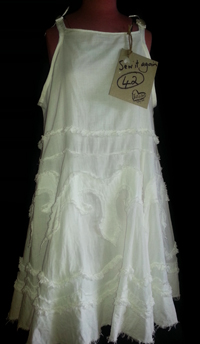
Sew 42 – Go Green for greater good

upcycled cotton muumuuResewing adventures are a way of creating and sharing ideas to magic discarded clothing into something else – long white cotton skirt turns muumuu by cutting armholes.

Our fashion habits and mores have led the world to the point where mountains of perfectly good clothing are being shipped around the world or sent to landfill.

This year I’m investing time, energy, creativity and skills to devise ways to refashion 365 outfits from old stuff in my wardrobes (yes, that’s plural) with the Sew it Again project.

The project is an initiative of the creative business/social enterprise Textile Beat, which made a splash last year at Brisbane’s Green Heart Fair. Notification came yesterday that the next Green Heart Fair run by Brisbane City Council as part of our city’s sustainability agenda is on June 1 and I’m looking forward to that.

Meanwhile, it’s Go Green Week in the United Kingdom (Feb 10 – 16) and I enjoyed these comments from University of the Arts London’s new Chair of Art in the Environment Lucy Orta. Continue reading

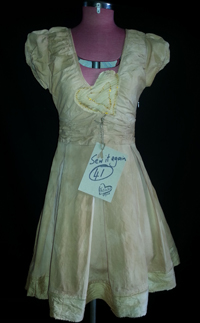
Sew 41 – Heart in the right place

eco-dyed cottonTo liven up this cotton $2 op shop dress, I eco-dyed it along with some silk which was then used to lengthen hemline and embellish neckline along with beads.

I’m making it my business this year to reinvent existing clothing to demonstrate how using creativity and effort enables us to dress in a different, more mindful, way.

My inspiration comes from seeing and reading what others are doing around the world, as documented by people such as Sass Brown in her books Eco Fashion and Refashioned.

Brown also has a website ecofashiontalk.com and today posted an article about creative challenges involved in upcycling post-consumer waste. Continue reading

Sew 40 – Changing clothes and habits

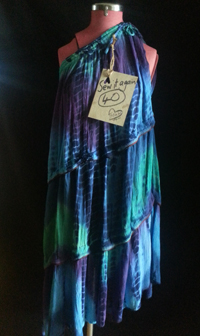
seablue muumuuSkirt becomes one-shoulder dress by creating an armhole, lifting the hemline in a few minutes to create a second life.

I’m refashioning a garment a day as a creative way to distil wardrobes of clothing horded or rescued from op shops because I appreciate their intrinsic value as natural resources.

For me this is not just about remaking and selling clothes at places like Reverse Emporium, it is about leading – demonstrating by actions – how simple old-fashioned home-sewing skills can empower us to dress in a different way.

My Sew it Again project emerged from postgraduate study with the Australian Rural Leadership Foundation through James Cook University which was transformative – it led to eco-leadership in an authentic space of my own making.

I’m tapping into a global sustainable fashion movement in the United Kingdom and United States which is raising awareness about where clothes come from and what is their true cost. Continue reading

Sew 39 – Towards zero waste

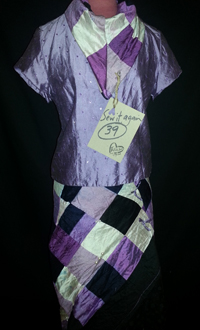
upcycled silk suitTransformed from two jackets, this outfit is for tonight’s opening of the Love Up-cycled exhibition at Reverse Emporium in Brisbane, which includes Textile Beat’s Sew it Again.

Am looking forward to meeting upcyclers likely to have similar values to mine – integrity, creativity, autonomy and purpose.

I’m proud to live in a city with a sustainability agenda that includes a Towards Zero Waste Strategy, and events such as the bi-annual Green Heart Fair which I attended last year. Other cities with zero waste strategies include San Francisco (they’ve just introduced a textile waste program) in the US, Vancouver in Canada and Kaikoura in New Zealand.

Brisbane City Council’s says on its website: “Zero Waste is a goal, a process, a way of thinking that profoundly changes our approach to resources and production. Not only is Zero Waste about recycling and diverting materials from landfills, it is also about restructuring production and distribution systems to prevent waste from being created in the first place. Zero waste ensures that resources already in existence are used to their maximum potential.”  Continue reading

Sew 38 – Scissors do the trick

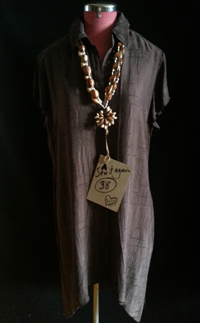
upcycled shirtmaker dressThis rework of a shirtmaker dress was quick and easy with a curved reshape of the hemline, scooped at the front, then the sleeves cropped and just zigzagged to finish.

I feel a bit of a butcher taking the scissors to such garments but my conscience is clear because its from an op shop, tossed out because a button fell off.

The fabulous thing about cutting and resewing existing clothing is you can experiment, have fun sewing and trying techniques without breaking the bank or wasting new resources.

I’ve been harvesting natural resources at ops shops for some time now, which is why I’m spending this year working my way through the stockpile and demonstrating a different way of dressing with Sew it Again. (My son Max laughed when I told him I’d filled up a loyalty card and got $50 of free stuff – ‘its like frequent flyer points’ he said.)

The whole idea of endless consumption of stuff and continual growth of society – which we’re sold as being good for the economy – is unsustainable. The Impossible Hamster video shows why. Then there’s this amazing video by the Planetary Collective which documents the Overview Effect felt by astronauts when seeing the beauty of Earth as a planet. Continue reading

Sew 37 – Consumerism creates waste

upcycled cotton outfitAnother day, another outfit – and another amazing new book! The Sustainable Fashion Handbook, by Sandy Black – which was just waiting on the library shelf for me to find.

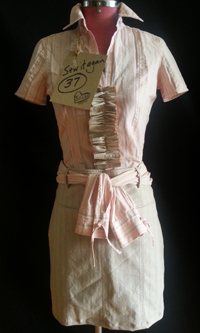
Today’s outfit is refashioned from items off the $2 op-shop rack, just one step away from becoming landfill yet barely worn. The shirt sleeves became a belt, extended by an offcut from skirt which helps blend the pink and beige stripe separates.

In her 2014 book, Professor Sandy Black says taken holistically the textile and clothing life cycles consume more energy and water than do the product lifecycles of any other industry except construction or agriculture – with cleaning, drying and ironing of clothes by consumers being especially costly. Continue reading